
What is adaptive optics?
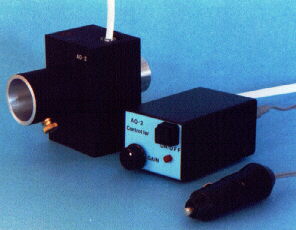
An adaptive optics system uses a flexible optical system with electronic feedback control to get better images in real time by compensating for atmospheric turbulence and image motion. Only a few major observatories now use adaptive optics, but its use is becoming more popular as the impressive results start coming out. The AO-2 is a simplified version, meant for amateur size telescopes. It corrects image motion due to atmospheric turbulence, clock drive error, and telescope vibration!
The AO-2 Adaptive Optics System from Stellar Products significantly improves your telescope's performance!
With the recent spectacular activity on Jupiter, the introduction of low-cost CCD cameras, and the new technology ultra-high resolution color films, interest in high resolution planetary photography is at an all-time high. The world's major professional observatories are upgrading their telescopes with sophisticated and expensive adaptive optics systems. Now you can be on the leading edge of amateur astronomy with the low-cost AO-2 adaptive optics system from Stellar Products.
The AO-2 works on all standard telescopes:
How to connect the AO-2 adaptive optics system to your telescope
The AO-2 system components attach directly to your telescope eyepiece holder, without any connections to your drive motors. The active eyepiece relay, the AO-2 controller, the connector cable, and the power supply cable are all shipped in a foam-lined protective carrying case. Your camera should be connected through your eyepiece projection system to get a magnified image on your film, or you can purchase the AO-2 CCD Lens adapter to connect your CCD camera directly to the AO-2.

Using the AO-2 is easy. To photograph Jupiter, for example, first use an eyepiece instead of your camera to focus the AO-2 and center the planet in the field of view. Remove the eyepiece and replace it with the AO-2. Slightly refocus for the sharpest image, then turn on the AO-2. The planet will be nearly motionless when the four alignment LEDs on the side of the active eyepiece relay are all darkened. Adjust the gain for maximum stability, and take your photos!
How the AO-2 Works
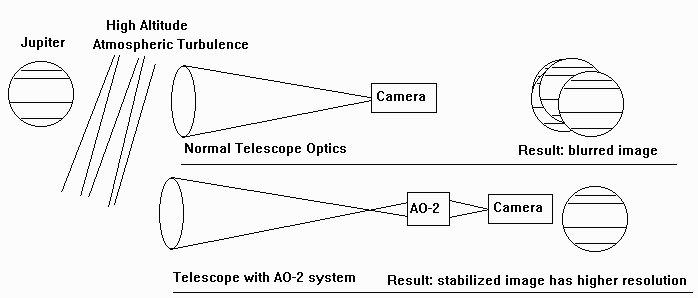
How the AO-2 really works!
The AO-2 uses modern technology in a compact package. A portion of the light coming from the telescope is split off and measured by a low-noise silicon photodiode quad cell. When the target is centered on the quad cell, the output signal is zero. When the target moves, due either to atmospheric motion or telescope vibration or clock-drive error, the signal coming from the quad cell is not zero. This error signal is amplified and sent to voice coil actuators which moves the input lens. Electronic feedback is used to keep the target on center and motionless.
Try this test. On any night when stars or planets are visible, put a high power reticle eyepiece in your telescope and carefully look for image motion. You can try this with a planet, but a close double star may show the effect a little better. Don't touch the telescope or drive corrector after the image is centered on the crosshair. Even on the best seeing nights, you will notice that the image wanders rapidly by a few arcseconds. This is probably not noticeable without the reticle, but your film or CCD will see the motion and record a blur. If you are looking at a double star, note that both components are moving in the same path, showing that image correction is useful over small angular dimensions. After a few minutes, you may have seen your target move 10 to 30 arcseconds off your original setting. This is due to clock drive or polar alignment error. If you calculate how much this large motion contributes to an exposure of only a couple seconds, you will probably find that the error amounts to several arcseconds. This image motion will cause a blur in your photographs. Each of these image motions will be substantially reduced by using the AO-2!
Normally, these problems won't bother the deep-sky photographer, but are devastating to the high resolution planetary photographer. Image stabilization, the simplest type of adaptive optics correction, will reduce these errors by anywhere from a factor of 2 to a factor of 10. Thus, instead of a blurred image, the image may be diffraction-limited! You will normally be able to photograph nearly everything you can see in the eyepiece.
Shown below are two photos of Jupiter taken only a few minutes apart. No changes were made to the focus, and the seeing conditions didn't change between exposures. The only difference is that one photo was taken with the AO-2 turned ON, and the other with the AO-2 turned OFF. When the AO-2 was turned off, the image motion created a blurred photo. To get these pictures, the AO-2 was connected between the telescope and the CCD camera and filter wheel. The difference between the images shows the importance of image stabilization!


AO-2 Features and Requirements
The AO-2 is meant for high resolution planetary photography, so good seeing is required to make the most advantage of its image stabilization. In addition, the AO-2 is characterized by:
(Specifications subject to change without notice)
While a 12" telescope is normally recommended for Saturn, Stellar Products has tried photography with a 10" telescope. The resolution improvement was about double, when the AO-2 ON photos were compared to the AO-2 OFF photos. The planet and rings were noticeably sharper. Since the rings are nearly edge-on, the Cassini division was still not quite resolved. Using image enhancement software with CCD camera images is probably the best recommendation for Saturn and the AO-2 with small telescopes.
The AO-2 is not meant for high resolution imaging of galactic centers, or other uses which are normally meant for professional observatories. The low cost of the AO-2 was specifically designed for planetary use, which meant sacrificing the ability to image very dim objects. In addition, adaptive optics works only on very small targets, under about 1 arcminute. The target must have a well-defined dark boundary, which means it doesn't work on the Moon or Sun.
The AO-2 does work well on the major planets, as the Jupiter and Saturn photos show. Stellar Products has also taken the first-ever full color image of the bright diffraction rings of a real star (Capella), using the AO-2 adaptive optics. That photo shows sub-arcsecond resolution, down to the diffraction limit. Ultra-high resolution Kodak Ektar 25 film was required to resolve the fine detail in the diffraction rings. The photo was a 9 second exposure at F/170, and even shows 0.2 arcsecond atmospheric refraction! When the AO-2 was turned OFF a few seconds later, all the film recorded was a practically invisible, smeared image, with no detail at all.
Using an eyepiece projector with 0.965" eyepieces
The AO-2 internal optics act like a Barlow lens, doubling the output focal ratio. In addition, the output focal plane must be just at the edge of the eyepiece holder. For this reason, the standard 1¼" eyepiece inside some eyepiece tele-extenders cannot get close enough to the AO-2 output focal plane for large projection ratios. Placing it as far as possible into the eyepiece projector still places the final relayed focal plane too far inside the eyepiece projector for the camera to focus properly. Usually, only the longer focal length eyepieces, giving a low magnification, may be used this way, depending on your particular equipment. One solution to getting the eyepiece closer to the desired position is to use a 0.965" eyepiece inside a 1¼" eyepiece projector. As shown in the diagram here, the barrel diameter is small enough to fit inside the first and narrowest section of some eyepiece projection tubes. Use small screws to hold and align the eyepiece, or simply wrap the eyepiece with black tape until it fits snugly inside the barrel without moving.
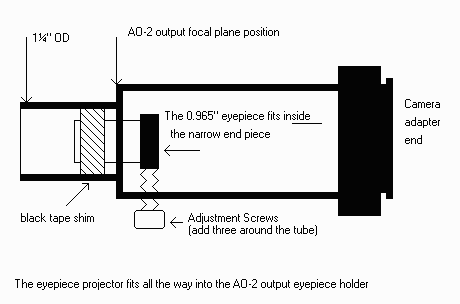
Remember that since the AO-2 magnification is 2x, the focal length for the eyepiece is twice as long as what is normally required. For example, a 12 mm focal length eyepiece will give about F/140 in eyepiece projection with a fixed length tele-extender.
Using the CCD Lens adapter
To take full advantage of high resolution CCD cameras requires a focal ratio of F/30 or more. This will create an Airy disc diameter in the visible spectral region about 30 microns. With pixel sizes near 15 microns, the Airy disc will be just adequately sampled. With pixel sizes around 10 microns, the Airy disc will be sampled three times, reducing pixel sampling noise even more.
CCD cameras are best used without an eyepiece projection system, since they usually provide too high a focal ratio magnification. In addition, the small chip size requires some kind of translation adjustment to center the image in the CCD.
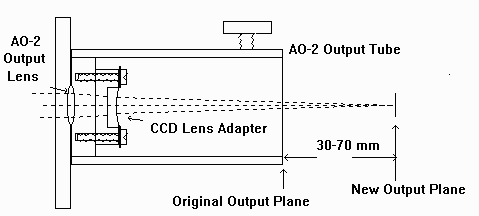
With these requirements in mind, Stellar Products has designed this CCD Lens Adapter. The output focal plane, instead of being flush with the output eyepiece adapter, is now moved outward by between 30 and 70 mm. The focal plane magnification is now between 3.5x and 5.0x instead of 2x, so when used with an F/10 telescope, the AO-2 will produce an output between F/35 and F/50, perfect for CCD cameras. The extra distance allows a color filter wheel between the AO-2 and your CCD. The lens also has some translation adjustment, so the planet image can be centered in the CCD. For visual use, you will need to add a right angle (star diagonal) eyepiece holder for the extra distance, as well as a longer focal length eyepiece.
All text and images are owned by Stellar Products, 1992-2003. Any use by others without permission of Stellar Products is prohibited.
Links to other Stellar Products pages: